
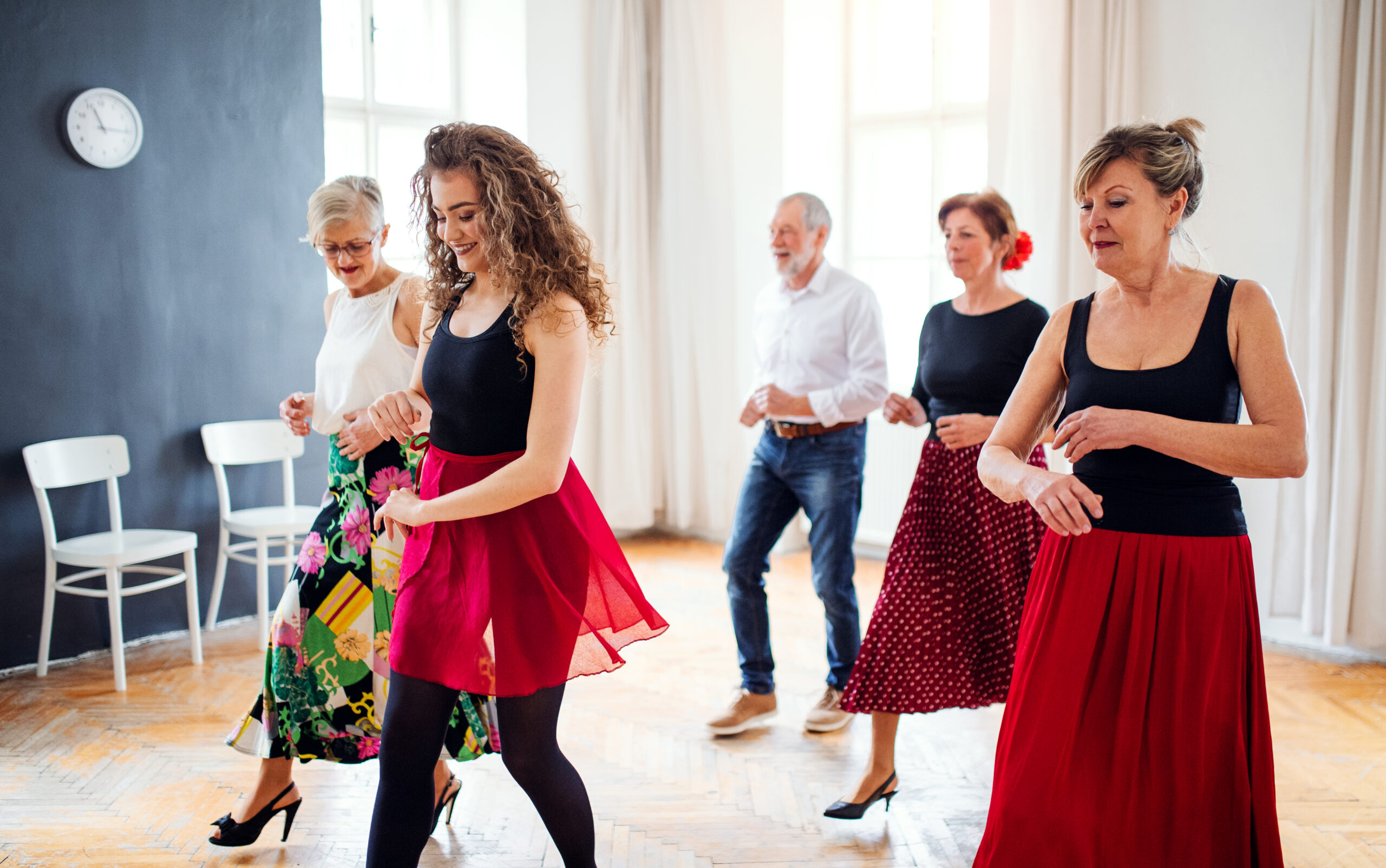
Group dance classes give beginners what most people need first: a chance to watch other people figure things out at the same time, lower pressure, and the kind of momentum that comes from being part of something larger than yourself. Private lessons have their place, but for most adults walking into a dance studio for the first time, a group class feels less intimidating and more like what they’re ready for.
Most people who think about dance lessons assume they’ll need one-on-one instruction to get anywhere. They picture themselves struggling with the steps, holding everyone back, or needing extra help just to keep up. So they consider private lessons—not because they want them, but because they think group classes will move too fast or expect too much. That assumption is backwards for most beginners.
You learn faster when you’re not the only one learning
Group classes put you in a room with other people who are also trying to remember which foot goes where. That context changes how learning feels. When you see someone else hesitate before a turn or mix up the timing, it stops feeling like a personal failing and starts feeling like a normal part of the process.
You also pick up things you wouldn’t notice in a private lesson. Watching someone else get corrected on posture or timing gives you information you can apply before you make the same mistake. And when you rotate partners—which happens in most beginner group classes—you get a feel for how the same step works with different people, which is closer to what dancing in the real world actually requires.
Private lessons keep the instructor’s attention on you the entire time, which sounds helpful until you realize it also means there’s nowhere to rest. Every mistake gets noticed. Every correction is for you. For someone who’s already self-conscious about trying something new, that level of focus can make the whole experience feel more stressful than it needs to be.
The room gives you something to measure yourself against
When you’re the only student, you have no idea if you’re doing well or badly. The instructor will tell you you’re doing fine, but you don’t know if that’s true or just encouraging. In a group, you can see where you stand without anyone having to tell you.
That’s not about competition. It’s about calibration. If everyone in the room is working on the same step and half of them are getting it wrong in the same way you are, you know you’re not behind. If someone who started the same week as you is nailing something you’re still figuring out, you also know it’s possible—and you can watch how they’re doing it.
Most adults underestimate how much they learn by watching. A private lesson eliminates that entirely. You have one model—the instructor—and they’re already fluent. A group class gives you a dozen models at different stages, which is closer to how most people actually absorb new movement.
Group classes cost less and commit you to less
A private lesson costs more per hour, and most studios recommend booking them in packages. That’s a significant financial and psychological commitment before you even know if you like dancing. Group classes let you try a session or two without feeling like you’ve locked yourself into something.
The lower cost also makes it easier to keep going. If you miss a week, it doesn’t feel like you wasted $100. If you decide dance isn’t for you after a month, you’re not stuck with a block of unused lessons. For someone who’s not sure yet, that flexibility matters.
Private lessons make sense for people who have a specific goal on a specific timeline—a wedding in three months, a competition, a role that requires choreography. But if your goal is just to learn how to dance without embarrassing yourself, the structure of a group class is usually enough.
You meet people, which makes it easier to keep showing up
Most beginners don’t expect the social part of group classes to matter as much as it does. But one of the main reasons people stop taking lessons is that they lose momentum, and momentum is easier to maintain when you know the person next to you or when someone notices if you don’t show up.
Group classes build that without requiring anything from you. You see the same faces each week. You partner with people who remember your name. You hear someone else say they almost didn’t come tonight either. It’s not a friendship requirement—it’s just the natural result of doing something with the same group of people more than once.
Private lessons don’t offer that. You show up, you work with your instructor, you leave. It’s efficient, but it’s also isolated. And for a lot of adults, especially those trying dance because they want to do something social, that isolation defeats part of the purpose.
According to research from the National Institute on Aging, social connection through shared activities has measurable effects on long-term well-being. Group dance classes deliver that as a side effect of just showing up.
When private lessons make more sense
Not everyone should start with a group class. If you have a wedding in eight weeks and need to learn one specific dance, a private lesson will get you there faster. If you have a physical limitation that requires modifications, private instruction gives you space to work at your own pace without worrying about slowing anyone down. And if you’ve already taken group classes and want to refine specific technique, privates let you focus on exactly what you’re trying to improve.
Some people also just prefer the privacy. If the idea of rotating partners or being in a room full of strangers feels like too much, a private lesson removes that variable. There’s no shame in that—it’s just a different starting point.
But for most people walking into their first dance lesson, the question isn’t whether private lessons are better. It’s whether they’re necessary. And for the majority of beginners, they’re not.
What a beginner group class actually looks like
If you’ve never been to one, it’s reasonable to wonder what you’d be walking into. Most beginner group classes last an hour. The instructor teaches one or two dances, broken down into small pieces you can follow without prior experience. You practice with a partner, then rotate so you’re dancing with someone new every few minutes.
The room is usually a mix of people—some who started last week, some who’ve been coming for a while but are still working on the basics. The energy is relaxed. No one expects you to get it right the first time, and mistakes are treated like part of the process, not something to apologize for.
You’ll probably feel a little lost during your first class. Most people do. But by the second or third week, the steps start to make sense, and the room starts to feel less like a roomful of strangers and more like the place you go on Tuesday nights.
Starting at Arthur Murray in Northern New Jersey
If you’re in Chatham, Denville, Morristown, or Ridgewood and you’ve been thinking about dance lessons but haven’t committed yet, a beginner group class is a good way to see what it’s like without overcommitting. You’ll work on foundational steps in dances like foxtrot, waltz, or swing—things that show up at weddings, parties, and social events—and you’ll do it alongside other people who are figuring out the same things you are. You can find details and schedules at arthurmurraydancenow.com.
Most people who eventually become confident dancers didn’t start with private lessons. They started in a group, with no idea what they were doing, and kept showing up until it made sense.
Leave a Reply