
What Happens in Your First Group Dance Class
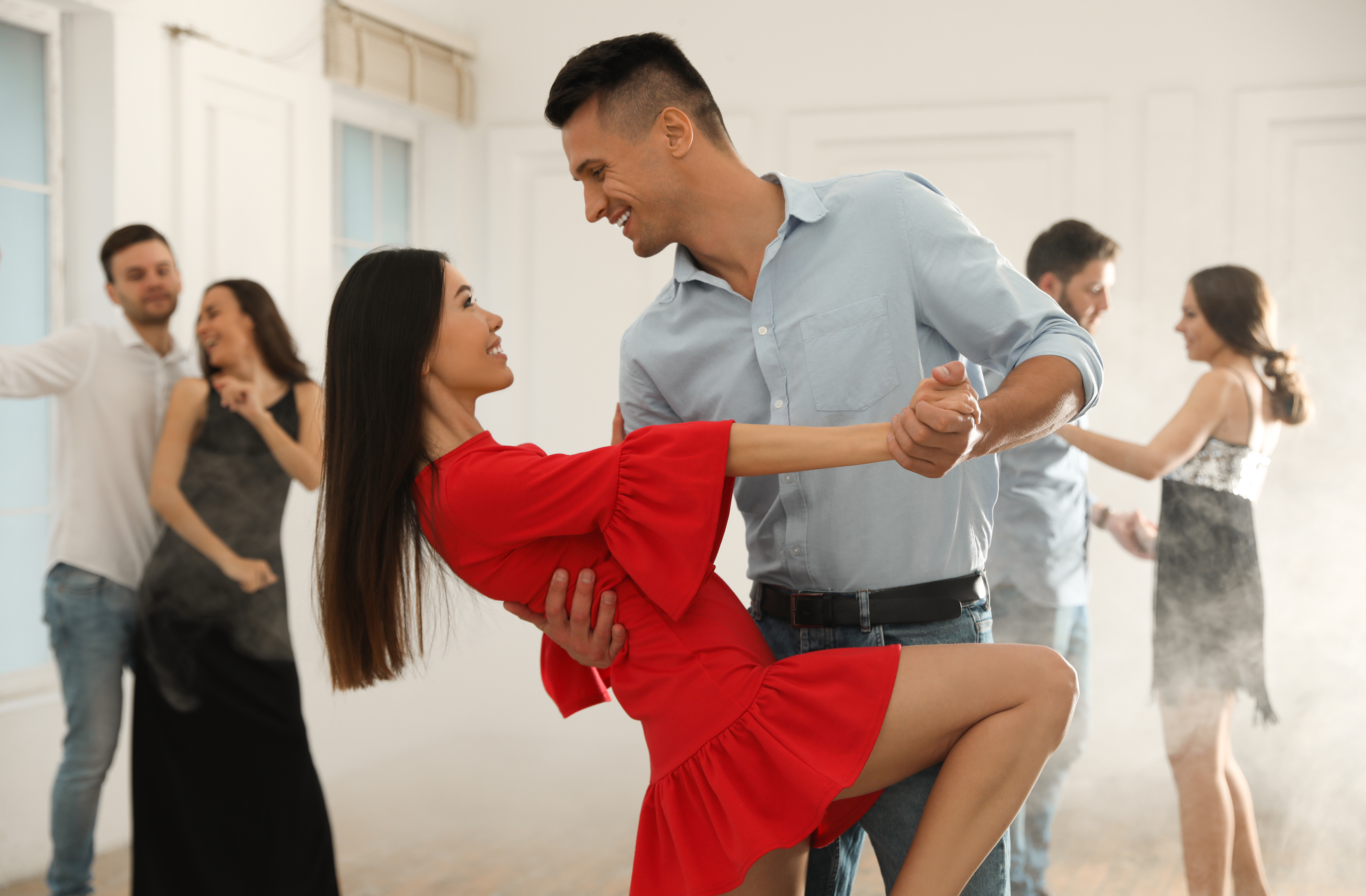
The instructor starts with a warm-up, nothing strenuous, just enough to loosen up your shoulders, relax your posture, and get you comfortable moving. Then they introduce the dance you’re working on that night, usually starting with the most basic step. They’ll demonstrate it slowly, break it down piece by piece, and walk the room while you try it. You’ll practice alone first, just walking through the footwork, before pairing up.
Once everyone has the footwork down, you’ll start rotating partners. That means you’ll spend a few minutes dancing with one person, then switch to someone new when the instructor calls for it. You’re not stuck with the same partner all night, and you’re not expected to know anyone before you walk in. The rotation is built into the structure of the class.
Between rotations, the instructor adds another piece, a turn, a change of direction, something to build on what you just learned. By the end of the hour, you’ve danced the same basic pattern with five or six different people, and it starts to feel less like memorization and more like movement.
How Partner Rotations Work in Group Dance Classes
Partner rotations happen every few minutes, and they’re announced by the instructor. You’ll hear something like “rotate” or “switch partners,” and everyone on the floor moves to the next person in line. If you’re leading, you move clockwise around the room. If you’re following, you stay in place, and a new partner comes to you.
The rotation isn’t arbitrary. It’s designed so that you experience different styles of leading or following, different heights, and different levels of experience. One partner might be steadier on their feet. Another might hesitate in the same spots you do. You learn faster when you’re not repeating the same interaction over and over with one person.
No one expects you to be good at this yet. The rotations aren’t evaluations. They’re just repetition with variety, and that combination is what makes the steps stick. You’ll also notice that the instructor rotates through the room during practice, spending a few seconds with each pair to give feedback or adjust your frame.
Do You Need to Bring a Partner to Group Dance Class
You don’t need to bring a partner. Most people show up alone, and studios balance the number of leaders and followers when they can. If the class ends up uneven, the instructor will rotate in as a partner, or someone will sit out for one rotation and jump back in for the next.
Some people bring a spouse or a friend, and that’s fine too. But even if you walk in together, you won’t be dancing together the whole time. The rotation still happens. The point of a group class is to learn from multiple partners, not to practice exclusively with the person you came with.
If you’re coming alone and that feels awkward, it won’t once you’re in the room. Everyone’s focused on not stepping on anyone’s toes, remembering which foot goes where, and figuring out how to relax their shoulders while also trying to look like they know what they’re doing. No one’s paying attention to who arrived with whom.
What Beginners Should Expect in Their First Group Dance Lesson
You’re going to forget the steps. You’ll get them for a minute, then lose them, then get them back. That’s not a sign you’re bad at this. That’s week one for everyone who’s ever taken a first group dance class.
The instructor will repeat themselves a lot, and they won’t seem bothered by it. They’ve taught hundreds of first lessons, and they know that the third time someone hears “step, together, step” is when it starts to make sense. You’re not holding anyone back by asking a question or needing to see a move again.
You’ll also spend more time standing still and watching than you expect. The lesson isn’t nonstop dancing. It’s short bursts of practice, then a pause while the instructor demonstrates the next piece, then another round of practice. That rhythm gives you time to absorb what you just tried before adding something new.
The other people in the room are a mix. A few might be on their third or fourth class and have the basic step down. A few will be just as new as you. No one’s performing. Everyone’s just trying to get through the hour without looking lost, and most of the time, that’s enough.
What to Wear and Bring to Your First Class
Wear something you can move in, nothing tight across the shoulders or restrictive around your knees. You don’t need dance shoes yet. A pair of clean sneakers or flats with smooth soles will work. Avoid anything with heavy tread or rubber that grips the floor too hard, because you’ll need to pivot and turn, and sticky shoes make that harder.
Bring water if you want it, though most studios have a cooler near the door. You won’t need a notebook. Some people bring one anyway and jot down notes between rotations, but the steps stick better through repetition than through writing them down.
Leave bags and jackets off the dance floor. Most studios have cubbies or benches along the wall. If you’re not sure what to wear to your first ballroom dance lesson, the short version is this: comfortable clothes, shoes that let you move, and nothing you’ll spend the whole hour adjusting.
The Real Purpose of a Group Dance Class
The steps are part of it, but they’re not the whole reason people keep coming back. Group classes give you a place to practice with different people, which teaches you how to adapt on the fly. You learn to follow someone who leads lightly, then someone who leads with more pressure. You learn to lead someone who anticipates your next move, then someone who waits for you to actually signal it.
That variability, dancing with people you don’t know, who move differently than you do, is what builds the skill that works outside the studio. At a wedding or a social event, your partner won’t move like your spouse or your regular instructor. They’ll move like themselves, and if you’ve only ever practiced with one person, that throws you. Group classes fix that.
The other thing group classes do is take the pressure off. You’re not the only person in the room learning. You’re not under a spotlight. You can make a mistake, laugh it off, and try again with the next partner. For a lot of people, that’s the part that makes adult group dance classes easier than private lessons — the room’s full of other beginners, and no one’s expecting anything close to perfect.
What Happens After Your First Class
You’ll probably feel like you retained about 40% of what you learned, and that’s accurate. The rest will come back when you take the second class and repeat the same material. Most group classes cycle through the same handful of dances over the course of a month, so you’ll see the same steps again soon.
Some people take a group class for a few weeks, get comfortable, and then add a private lesson to work on something specific. Some stay in group classes for months. There’s no required path. You’re not signing up for a program when you walk in for the first hour, you’re just seeing whether this is something you want to keep doing.
If you liked the way it felt to move with music, or if you liked having an hour that had nothing to do with work or home or the long list of things you’re supposed to be doing, that’s reason enough to come back.
Arthur Murray’s locations in Chatham, Denville, Morristown, and Ridgewood run beginner group classes throughout the week, and you can drop in without committing to a series. If you’ve been thinking about it longer than you’ve been ready to try it, the first group dance class is the place to start.
Most people who eventually become dancers spent a long time assuming they wouldn’t be good at it. Then they walked into a room, rotated through a few partners, and realized no one expected them to be good at it yet.
Leave a Reply